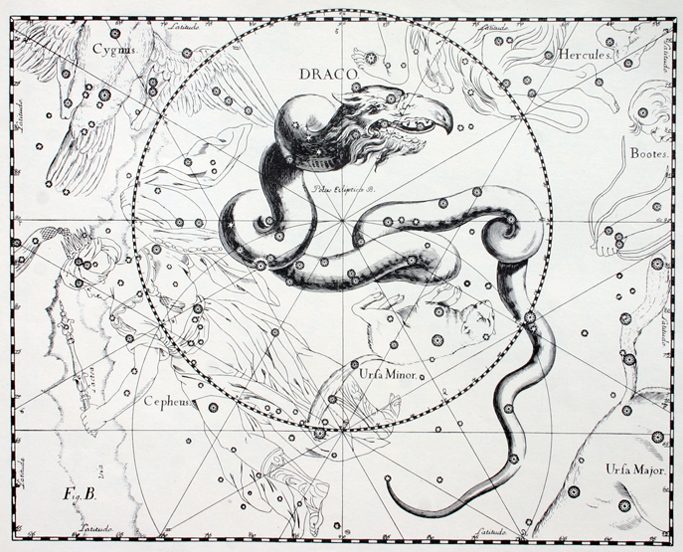
The myths would not make any sense if there were not a landscape as the backdrop. When we look at the night sky we are enveloped by a random sea of stars. At most we may be able to discern the Milky Way, but few observers would see any other landmarks in the inky darkness. But the ancient peoples that spent much more time under the stars had some additional markers.
Virtually every ancient culture recognized that the stars near the North Polar region, remained in place while all others appear to rotate around this central point. This was considered the “highest seat of heaven” and the hub of the universe. At times it was referred to as the highest mountain. For the Greeks it was the celestial home of the immortal gods on Mt Olympus. The Olympic pantheon were located near this region, or had occasional excuses for disappearing.
The Milky Way cuts a swath across the sky which is near the North Polar region on one side an the South Polar region on the other side. Many of the gods and goddesses found in the Milky way constellations of the Northern hemisphere, rule over cities, justice, marriage or trade, such as Athena, Hera and Hermes. In short. they live in the populated regions of the sky and ruled over those aspects of life.
Moving into lower celestial latitudes we find some of the rural gods and goddesses, which ruled over agriculture or were occasionally known for entering the Underworld for months at a time. This region, bordering the celestial equator is the home of rise and set stars, which have given birth to the myths of dying and resurrected gods. For the Greeks, Persephone was the goddess who spent a good portion of the year in the Underworld, but whom was allowed to return to Earth seasonally bringing back a period of fertility. Demeter, the Corn Goddess, and Dionysus, God of Wine, are another occupants of the “earthly realm.”
A third region of the night sky defined by several ancient cultures was called “the Sea.” This is a particularly dark patch of the night sky, contained some of the larger, yet dimly lit constellations. All of the “watery constellations” of the zodiac, including Pisces, Aquarius, and Capricorn (the Goat-Fish) are found in the stellar sea, as well as Poseidon, god of the sea, Thetys, goddess of the sea and Aphrodite, goddess of beauty who is born from the foaming sea.
The further south one ventures from the North Celestial pole the more one finds themselves in the wild lands, where the famous hunter and keeper of wild animals roams, namely Artemis. Even further south are the monsters and gatekeepers of the Underworld, who are represented by the constellations that never rise high above the horizon, where life ends and death begins. The Underworld is the land of the dead, quite literally under the world we know and below the horizon that obscures our vision from penetrating the shades.
The final place of darkness is the divine prison of Tartarus at the bottom of the abyss. The abyss seems to have led through the center of the earth from the highest heaven of the North Celestial Pole to the lowest depths of the South Polar region, where we find the transgressors
 Decoding the Night